
Botox for Headaches and Migraines: Can It Help?
Can Botox relieve headaches or migraine? Learn the difference between cosmetic Botox for muscle-related tension and specialist medical Botox for chronic migraine.
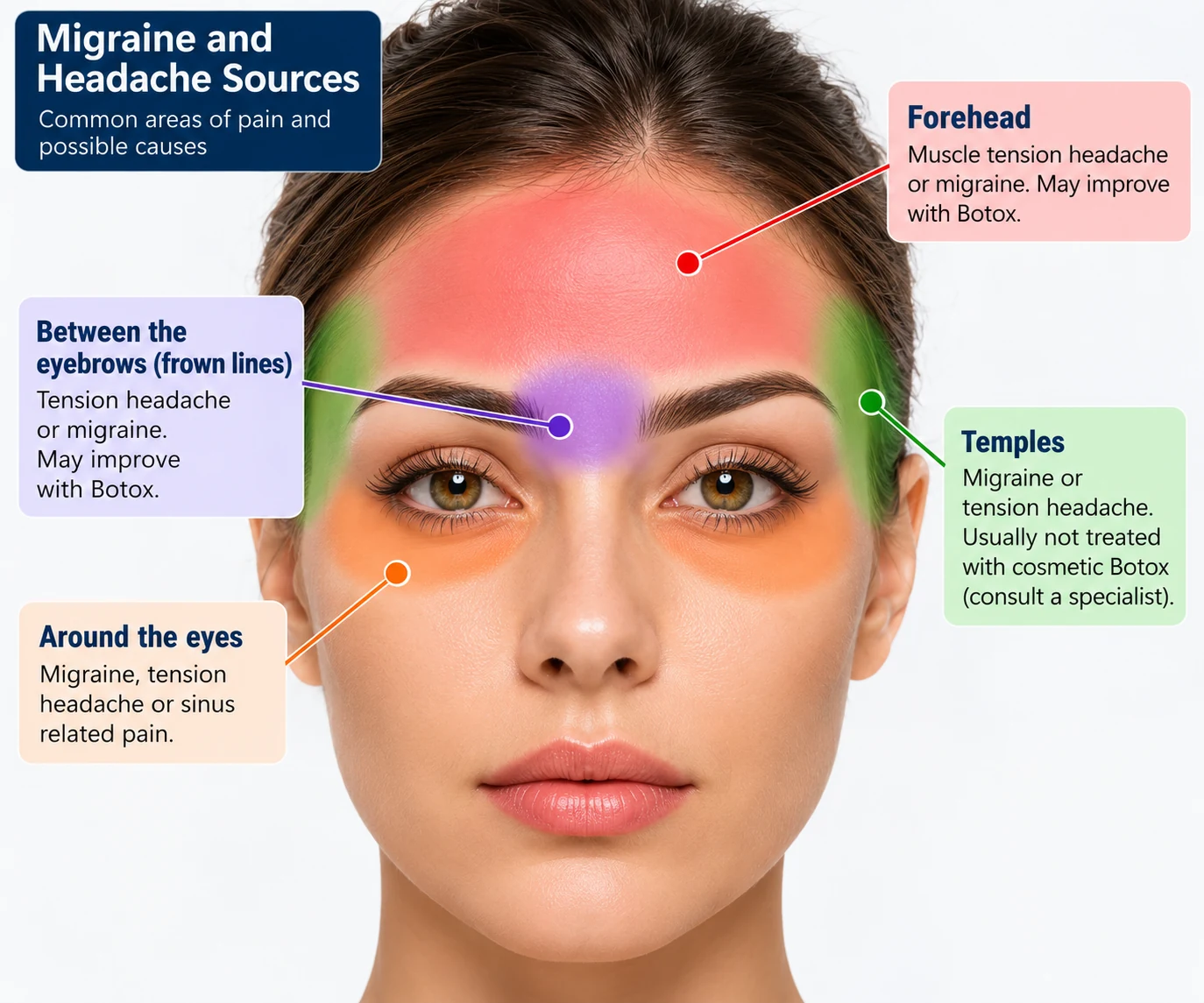
Can Botox for forehead wrinkles and frown lines also help relieve headaches and migraines? The answer depends on the type of headache, the muscles involved, and the underlying cause.
Botox is widely known for softening expression lines in the forehead, frown lines, and crow's feet. It also has medical applications, including specialist preventive treatment for chronic migraine. At Dr Omar Al Khalili Clinic in Umm Al Sheif, Dubai, patients sometimes ask whether cosmetic Botox in Dubai may also help with their headaches.
This guide explains what cosmetic Botox may and may not do. It is educational information, not a diagnosis or a substitute for assessment by a doctor, neurologist, or headache specialist.
Can cosmetic Botox relieve headaches?
When cosmetic Botox is injected into the three common facial treatment areas—forehead lines, frown lines, and crow's feet—it relaxes selected muscles responsible for facial expression. Some patients experience an additional benefit when their discomfort is associated with repeated forehead contraction or frowning.
For example, a person who frequently contracts the forehead muscles or frowns throughout the day may develop muscular tension around these areas. By reducing activity in selected muscles, Botox may reduce muscle-related tension and discomfort for some patients.
That does not mean every forehead headache is caused by the forehead muscles. Migraine is a neurological disorder, and the location of pain alone does not identify its cause.
Can Botox stop migraines?
Botox is an established preventive treatment for chronic migraine, but cosmetic Botox and medical Botox for migraine are not the same protocol.
Cosmetic Botox usually involves selected injections in three facial areas:
- Forehead
- Frown lines between the eyebrows
- Crow's feet around the eyes
These injections may improve muscle-related headaches in some patients, but they are not equivalent to a specialist-directed chronic migraine protocol. Medical Botox for chronic migraine involves injections into several muscle groups across the head and neck, usually following a specific protocol administered by an appropriately trained specialist.
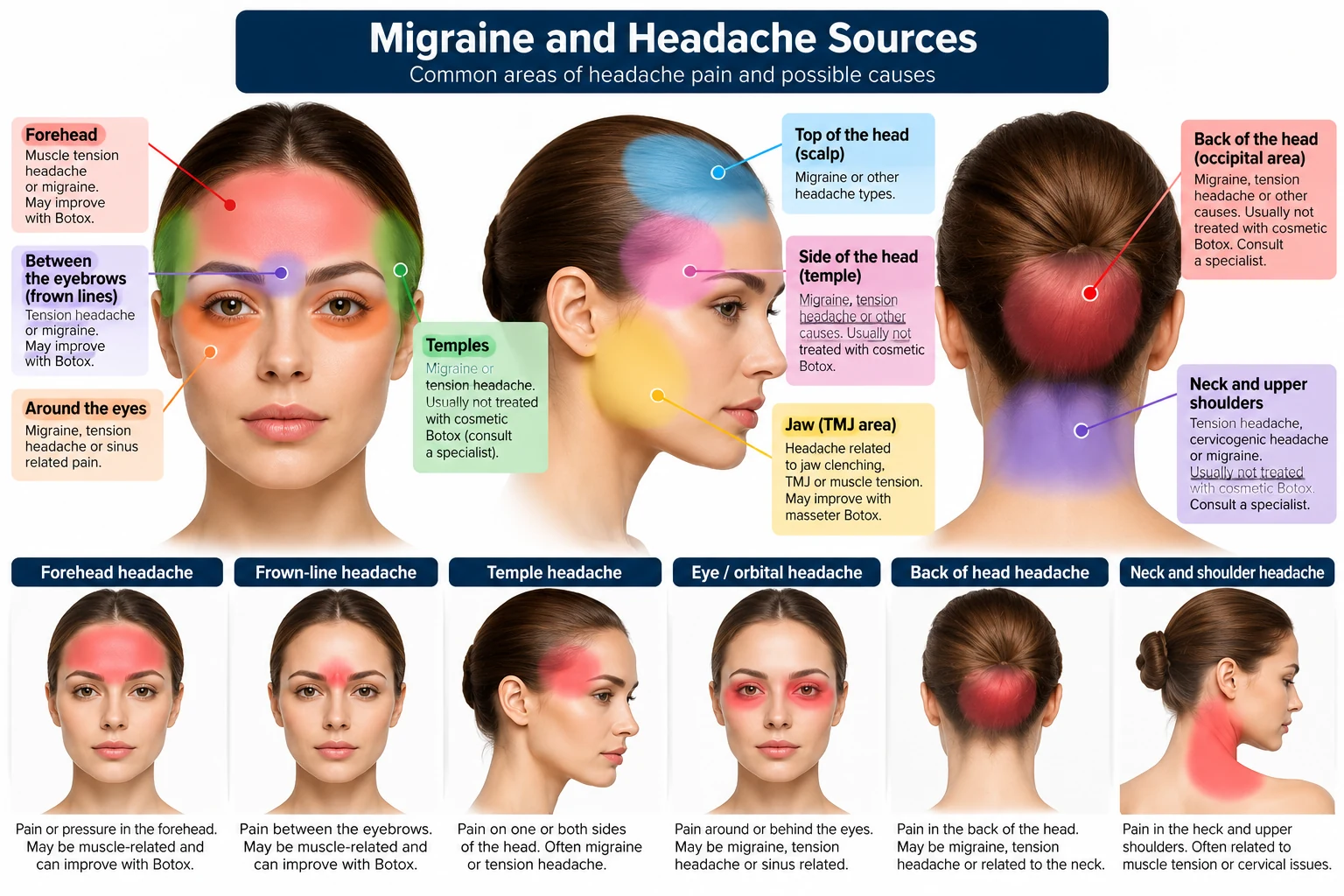
Some patients receiving cosmetic Botox notice that their headaches improve. Others experience no change. A consultation should avoid presenting cosmetic Botox as a guaranteed migraine treatment or cure.
What if the headache comes from another area?
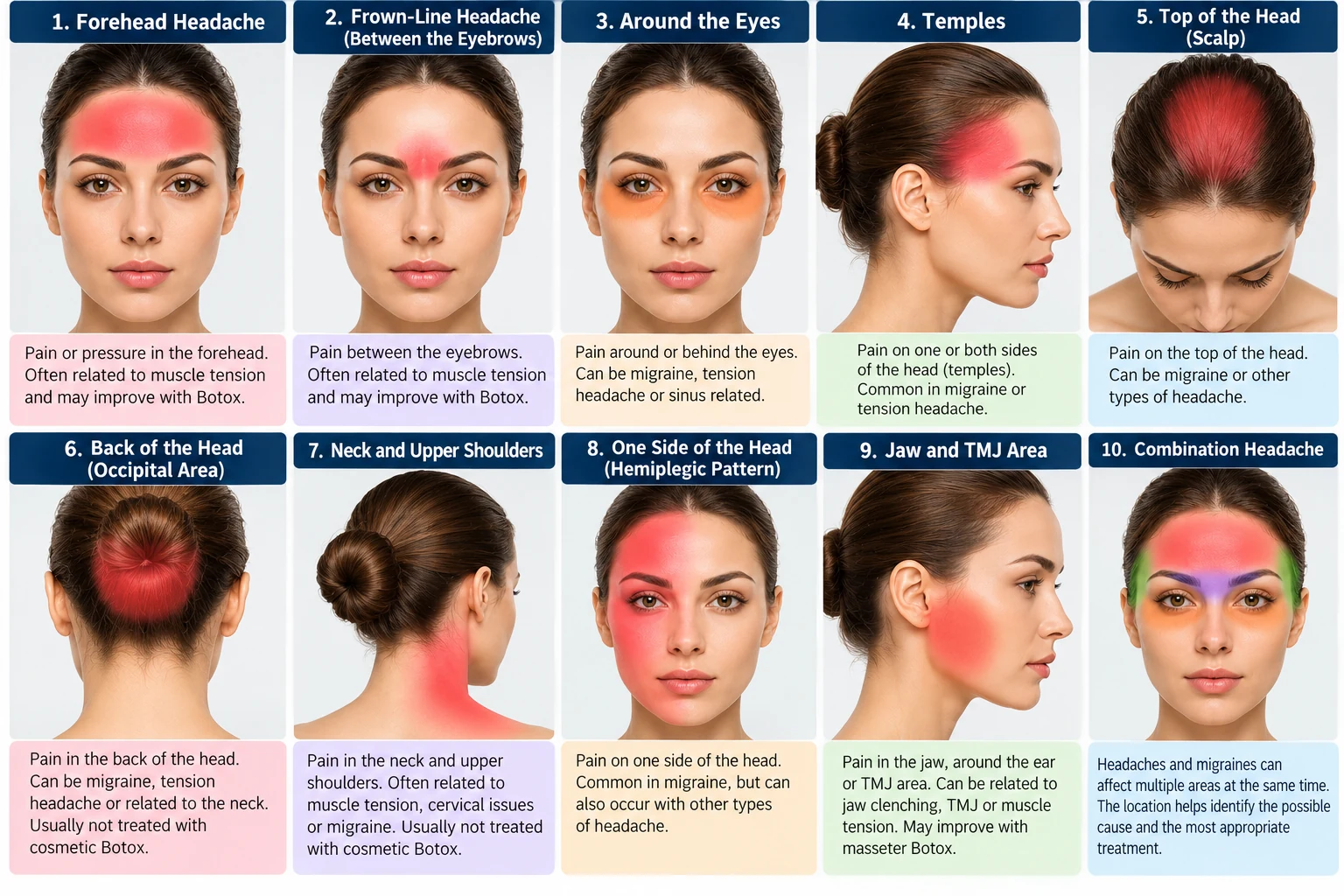
Headaches and migraines can involve several regions, including the temples, top of the head, back of the head, neck and shoulders, around or behind the eyes, or one side of the head.
- Temples: Pain on one or both sides of the head may occur with migraine, tension headache, or other causes.
- Back of the head: Occipital pain may be associated with neck disorders or other headache conditions.
- Neck and shoulders: Muscle tension or cervical conditions may contribute to headache symptoms.
- Around or behind the eyes: Pain may occur with migraine, tension headache, sinus-related pain, or other conditions.
- One side of the head: This is a common migraine pattern, although migraine can occur in other locations.
If headaches are frequent, severe, or associated with these areas, consult a neurologist or headache specialist to establish the correct diagnosis and treatment. Cosmetic Botox should not be used to delay assessment of recurrent or concerning symptoms.
Can Botox cause headaches after cosmetic treatment?
Yes. Although Botox may help certain muscle-related headaches, some patients experience a temporary headache following cosmetic Botox injections. These headaches are usually mild and may last approximately two to three days.
Possible contributing factors include injection-related discomfort, local muscle responses, or temporary changes in muscle activity. Occasionally, patients report headaches lasting longer, sometimes up to 10–14 days. A persistent, severe, worsening, or unusual headache should be medically assessed rather than automatically considered a routine Botox reaction.
Seek urgent medical attention for a severe or unusual headache, especially if it is associated with neurological symptoms such as weakness, confusion, fainting, difficulty speaking, vision loss, or a sudden onset unlike previous headaches.
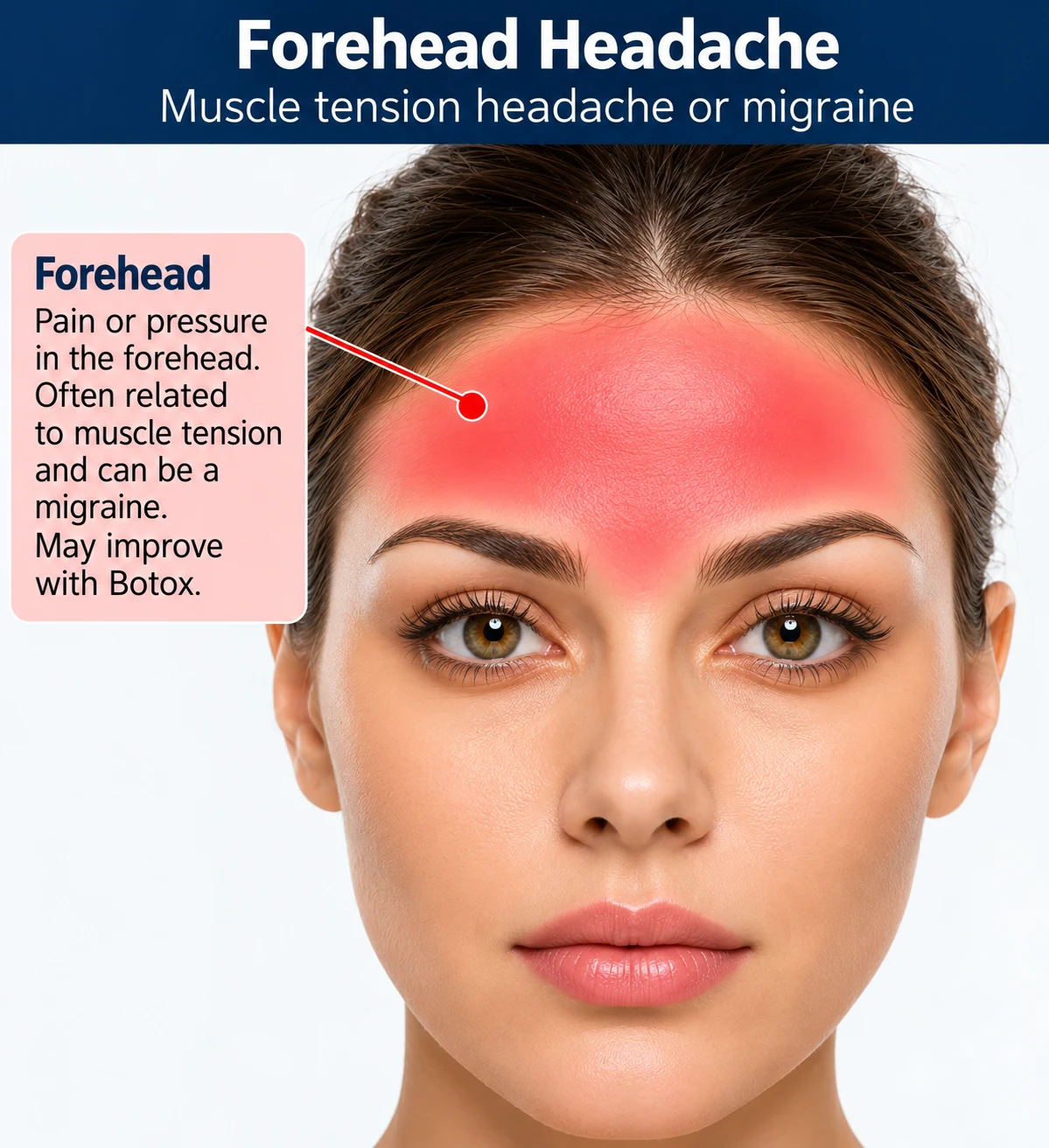
Who may benefit from cosmetic Botox for forehead-related headaches?
Cosmetic Botox may be considered for patients who have visible forehead wrinkles or frown lines, frequently contract their forehead or frown muscles, experience muscular tension in these regions, and want cosmetic improvement while understanding that headache relief is not guaranteed.
If you are considering treatment, the doctor should review your headache pattern, medical history, current medicines, previous treatments, and aesthetic goals. For recurrent migraines or severe headaches, specialist medical assessment remains important.
Frequently asked questions
Can Botox in the forehead stop my headaches?
It may help when headaches are associated with excessive muscle contraction or tension in the forehead. However, not all forehead headaches originate from these muscles.
Can frown-line Botox help with headaches between the eyebrows?
Some patients may experience relief from muscle-related tension in this area because Botox relaxes selected muscles involved in frowning. It is not a guaranteed treatment for every headache.
Does Botox in three cosmetic areas cure migraine?
No. Cosmetic Botox may improve headaches in some patients, but it is not a proven cure for migraine and does not replace specialist-directed migraine treatment.
Why did I get a headache after Botox?
Temporary headaches can occur following injections and generally settle within a few days. Contact your treating medical professional if symptoms are severe, unusual, worsening, or prolonged.
Can Botox cause headaches for two weeks?
Some patients report prolonged headaches, but headaches lasting 10–14 days should be evaluated rather than assumed to be a routine side effect.
Should I see a neurologist for migraine?
Yes. Recurrent migraines, severe headaches, neurological symptoms, or pain involving the temples, back of the head, neck, or other regions should be evaluated by a neurologist or headache specialist.
Botox for headaches and migraines in Dubai
At Dr Omar Al Khalili Clinic in Umm Al Sheif, Dubai, cosmetic Botox treatments are designed to relax selected facial muscles, soften expression lines, and provide natural-looking aesthetic results. Some patients may also experience relief from muscle-related forehead or frown-line headaches, but individual results vary.
If you are considering Botox treatment in Dubai for forehead wrinkles, frown lines, or crow's feet, a consultation can help determine whether the treatment is appropriate for your aesthetic concerns. For persistent or recurrent migraines, assessment by a neurologist or headache specialist is recommended.
Book a Botox consultation in Dubai to discuss your concerns with Dr Omar Al Khalili.
Have a question about this?
Book via WhatsAppExplore related care